
Evaluation of the Performance of the Poti City Council (2021-2025)
Introduction:
Transparency International Georgia has evaluated the performance of the Poti Municipality City Council of the 2021 convocation. The report is based on information requested from the City Council and that posted on the City Council’s official website, as well as on the observations of our organization. The study covers the period from November 2021 to May 2025.
Transparency International Georgia has evaluated the performance of the Poti City Council three times, with reporting periods including November 2017 to 2019, and the years 2020, 2022 and 2023.
Chapter 1. Key Findings
- During the reporting period, the Poti City Council exercised weak oversight over the Poti City Hall and legal entities established by it. The oversight over the officials and individual agencies accountable to the City Council was formal.
- No instances of conflicts of interest, incompatible activities with the civil service, or violations of ethical norms and rules of procedure were identified at the Poti City Council.
- Out of 22 Poti City Council officials, only one submitted an inaccurate declaration.
- During the reporting period, the three factions operating in the City Council introduced a total of eight initiatives. The City Council approved all six initiatives of the Georgian Dream - Democratic Georgia faction but rejected both initiatives of the United National Movement (UNM).
- Despite the minimal level of activities carried out by the factions, the expenses allocated for their operations were disproportionately high, totaling GEL 1,588,639.
- The Poti City Council abolished the Gender Equality Council on May 30, 2025, without the Council having conducted either an analysis of legal acts or an expertise on draft legislative acts. A Municipal Council on Women and Children’s Issues was established instead.
- The Poti City Council's attendance rate at meetings was consistently low throughout the 2021 convocation. City council members were absent from meetings a total of 239 times, 219 of which were without valid reasons.
- We do not have 2024-2025 data on the number of speeches delivered by City Council members at its sessions, though this figure was quite low in 2022-2023. In 2023, 15 out of 35 members did not exercise this right. 23 members did not present their reports. In 2022, 11 members did not exercise their right to speak, and 27 did not present reports.
- During the reporting period, no settlement meetings were held in the Poti Municipality, and only one petition was filed with the Poti City Council.
- The Poti City Council spent GEL 6,047,527 during the reporting period, of which GEL 5,167,504 was allocated for wages.
- The City Council consumed 106,683 liters (106.6 tons) of fuel worth GEL 294,248 during the reporting period.
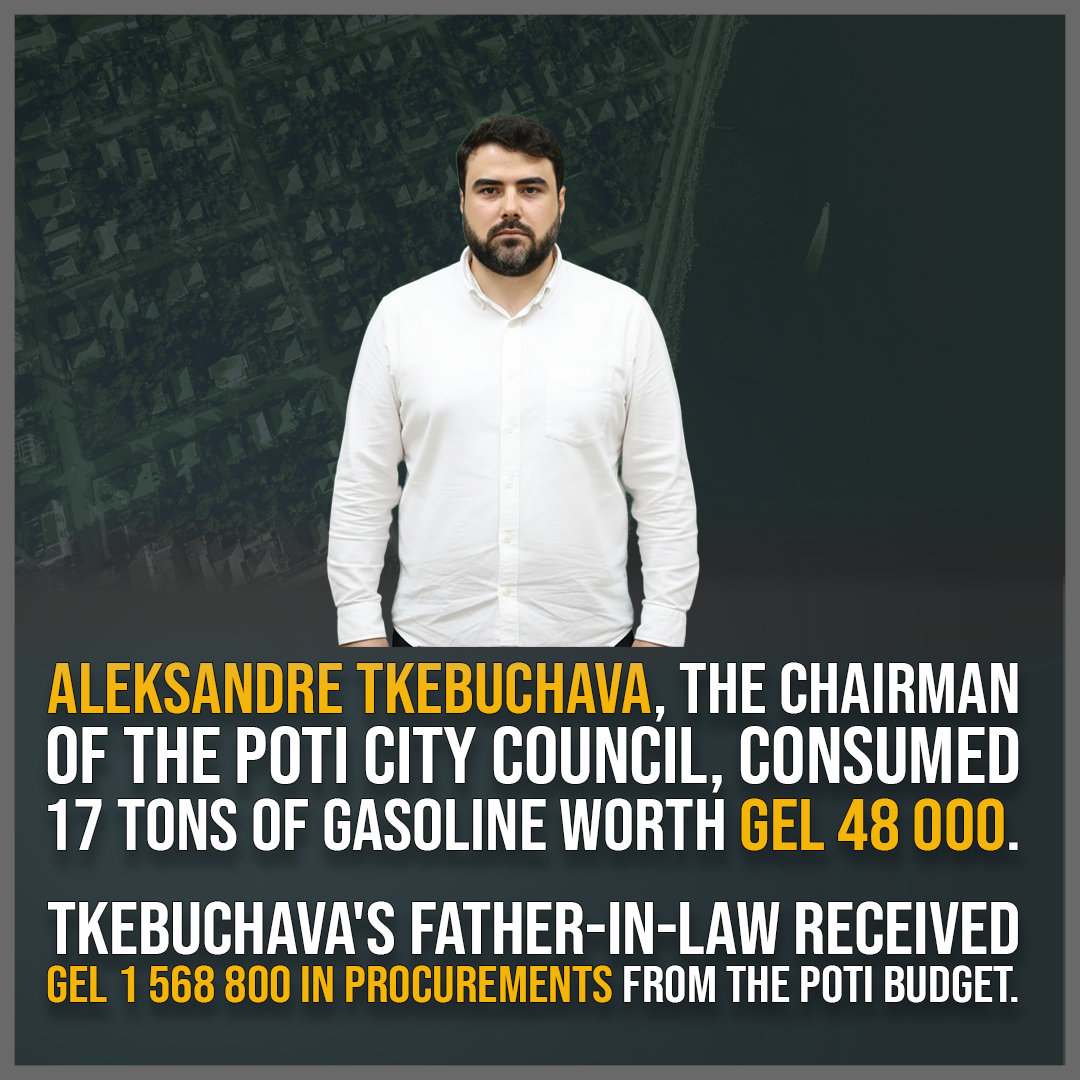
- Out of this total, Aleksandre Tkebuchava, the chairman of the Poti City Council, consumed 15%. From December 2021 to May 2025, he used 17,037 liters (17 tons) of fuel worth GEL 48,007. This amount of fuel could travel an average of 212,500 kilometers, which is equivalent to circling the Earth five times.
Chapter 2. General information about the Poti City Council
The Poti City Council has 35 members, seven of whom are elected in single-mandate majoritarian electoral districts, and 28 members are elected proportionally.
- Initially, the mandates in the Poti City Council were distributed as follows: Georgian Dream-Democratic Georgia - 20 mandates, United National Movement (UNM) - 11 mandates, Gakharia for Georgia - 4 mandates.
- After some members of the United National Movement left to form the Ahali party, the UNM was left with nine members on the City Council, compared to two members of Ahali.
- Out of the 35 City Council members, 10 are women, accounting for 28% of the total membership. While only one woman held an official position on the previous City Council, today there are four.
- Out of the 35 Poti City Council members, 22 held official positions.
- During the reporting period, the Poti City Council held 47 sessions, with only eight of them being extraordinary.
- The Poti City Council approved a total of 128 resolutions. Of these, 103 were authored/initiated by the Mayor of Poti, and 25 by separate City Council commissions.
- During the Poti City Council’s tenure, five commissions were established, which held a total of 199 sessions throughout the reporting period and submitted 192 draft legal acts to the Poti City Council. The commissions also prepared 422 conclusions on the compliance of the projects to be considered by the City Council with the legislation.
- There were three factions working in the City Council: Sandro Kushashvili, chairman of the Georgian Dream-Democratic Georgia faction, had six deputies; Ana Jojua, chair of the United National Movement faction, had two deputies; and Gigla Turkia, chairman of the Poti for Georgia faction, had one deputy.
- The Georgian Dream-Democratic Georgia faction introduced six initiatives, five of which were introduced in 2022 and all of which were reflected in the budget. The United National Movement had two initiatives, neither of which were adopted by the City Council. The Poti for Georgia faction did not propose any initiatives.
- Despite the minimal level of activities carried out by the factions, the expenses allocated for their operations were disproportionately high, totaling GEL 1,588,639.
- The Poti City Council's attendance rate at meetings was consistently low throughout the 2021 convocation. City council members were absent from meetings a total of 239 times, 219 of which were without valid reasons.
- The City Council did not provide 2024-2025 data on the number of speeches delivered by City Council members at its sessions, though this figure was quite low in 2022-2023. In 2023, 15 out of 35 members did not exercise this right. 23 members did not present their reports. In 2022, 11 members did not exercise their right to speak, and 27 did not present reports.
Chapter 3. Oversight over Bodies Accountable to the City Council
During the reporting period, the Poti City Council heard reports from individual legal entities and evaluated the performance of the City Hall services positively. The Council also found no evidence of misconduct in the activities of the Mayor, as well as conflicts of interest, and/or facts of incompatibility of positions. However, studies published by Transparency International Georgia, the conclusions of the State Audit Office, and information disseminated by other sources show the opposite:
- Transparency International Georgia published a study in 2022, which found that the Poti Municipality established N(N)LEs whose functions were duplicated with one other or with other state or local government agencies. An unreasonably large number of staff positions were created in the management and administration of individual N(N)LEs. The municipality also created several N(N)LEs in the fields of sports, education, and culture to provide one type of service.
- The challenges facing legal entities are discussed in the 2022 State Audit Service report. However, despite the recommendations from Transparency International Georgia and the Audit Service, the City Council did not activate the control mechanisms at its disposal. Furthermore, the City Council rejected the UNM faction’s initiative to create a working group regarding the State Audit Service report.
- In May 2023, Squander Detector disseminated information about the involvement of Zurab Meskhi, the father-in-law of Aleksandre Tkebuchava, the chairman of the Poti City Council, in state procurements. According to this information, after Tkebuchava was first elected executive secretary of Georgian Dream’s Poti office and then chairman of the City Council, Zurab Meskhi received GEL 1,568,800 in procurements from the local budget.
Chapter 4. Incomplete asset declarations and alleged cases of nepotism
A total of 22 Poti City Council officials were required to complete asset declarations. Of those, only one submitted an inaccurate declaration.
Tornike Kharchilava - Chairman of the Poti City Council Commission on Property Management and Natural Resources

In his asset declaration from August 2024, Tornike Kharchilava stated that he owns a 40% stake in “Potigalvanizmetal” LLC. He also indicated in the declaration that he transferred the share to another person for management. However, the public registry does not show any record of this transfer.
An analysis of declarations submitted by Poti City Council officials revealed that three officials’ family members work in municipal agencies. Namely:
- Abesalom Pertaia, the husband of First Deputy Chairperson of Poti City Council, Maia Dolbaia, has worked as a specialist at the N(N)LE City of Poti Municipality Sports and Tourism Center since September 2023.
- Tengiz Dundua, the father of Temur Dundua, the Chairperson of the Finance and Budget Commission of Poti City Council, is the head of the department at the N(N)LE Center for Maintenance of the Cemetries of Poti. His wife, Buta Natsvlishvili, worked as a chief specialist at the N(N)LE Poti Municipality Service Center until October 2023.
- According to the asset declaration of Nikoloz Izoria, deputy chairman of the Georgian Dream faction in the Poti City Council, his wife, Nino Chochua, is the chief specialist at the Poti Municipality Sports and Tourism Center.
Unlike the process of appointing civil servants, employment in municipal legal entities does not typically involve a competitive selection process. The mayor unilaterally appoints the head of the N(N)LE or LLC; accordingly, the head of the N(N)LE also makes unilateral decisions about staffing. This practice, on the one hand, does not allow for the selection of highly qualified specialists for vacant positions through a competitive process. On the other hand, it carries the inherent risks of nepotism and party-based employment within budgetary organizations.
Chapter 5. Gratuitous transfer of property to the state
In 2024, the National Agency of State Property received a 198.00 sq/m of non-agricultural land plot owned by the Poti Municipality and located in Kokaia Alley in Poti.
In 2023, the Poti City Council transferred only one property to the state free of charge - a 7 sq/m land plot located on Paliashvili Street in Poti. Subsequently, the plot was included in the capital of the LLC United Water Supply Company.
In 2022, the Poti City Council transferred the following properties to the state free of charge:
- The Poti Theater building and the land on which it is located;
- A VOLKSWAGEN PASSAT vehicle owned by the Poti Municipality with the registration number EE099HH;
- Three plots of land in Poti, located on Tavdadebuli Street. Later, the National Environment Agency was granted the right to use this plot;
- A 900-square-meter non-agricultural plot of land located on Kostava Street 1 in Poti, near the Public Service Hall;
- A 4279.00-square-meter non-agricultural plot of land located on Baratashvili Street in Poti.
Chapter 8. Citizen engagement in the City Council’s activities
The Poti City Council has adopted all the regulations specified by law to ensure citizen involvement in municipal activities, including those of the City Council:
- Although the typical regulation of the general assembly of a settlement was approved, the assembly itself has not yet been held in the Poti Municipality, so citizens have not yet had the opportunity to benefit from this engagement mechanism.
- An electronic system for submitting petitions has been introduced. However, only one petition was registered with the Poti City Council during the reporting period.
- Citizens can submit concrete initiatives and request information electronically through the municipality’s website.
- According to a special rule, citizens have the right to apply to the City Council two days before a session and register as a speaker or co-speaker, as well as make a special statement at the session. However, this rule does not limit citizens’ ability to do so without registering.
- Sessions of the City Council are broadcast on social media.
- Officials of the Poti City Council submit performance reports twice a year.
- The City Council holds public budget discussions with the City Hall.
Chapter 10. Expenditures of the Poti City Council
During the reporting period, the Poti City Council’s expenditures amounted to GEL 6,047,527.
- The majority of the expenses, GEL 5,167,504 (85.4% of the total) were allocated to labor remuneration.
- A total of GEL 83,732 was paid in bonuses, awards and supplements.
- The Poti City Council has one vehicle on its balance sheet, a 2022 Kia Seltos purchased by the municipality in June 2022 for GEL 65,000.
- The Poti City Council consumed 106,683 liters (106.6 tons) of fuel worth GEL 294,248 during the reporting period.
- Aleksandre Tkebuchava, the chairman of the Poti City Council, used 15% of the total fuel consumed. From December 2021 to May 2025, he used 17,037 liters (17 tons) of fuel worth GEL 48,007. This amount of fuel could travel an average of 212,500 kilometers, which is equivalent to circling the Earth five times.
- The fuel limit for other City Council officials is 110-140 liters.
- During the reporting period, the Poti City Council incurred other expenditures: reimbursement for activities of the City Council members – GEL 412,576; telephone communication - GEL 45,352; business trips - GEL 38,115.
Recommendations
Today, Georgia is experiencing a total decline in democratic standards, political polarization, and a severe weakening of the role of self-governments. In order to develop local democracy, it is necessary to:
- Establish a legislative framework that ensures the independence of municipalities and their representative bodies - city councils.
- Strengthen mechanisms of balance, mutual oversight, and transparency at the local level.
- The City Council should be given formal and real levers to oversee and hold accountable the executive branch of government - City Hall.
- The City Council’s independence should be protected and guaranteed by legislation so that it can fully and effectively control the policies and administrative processes implemented by City Hall, without any political pressure.
The aforementioned transformations will only become possible if a democratically elected parliament, which is based on pluralistic values, creates legislation that is not aimed at protecting narrow party interests, but rather establishes citizen-oriented local self-government - transparent, accountable, and truly effective.