
Management or Elimination – What Threat Does the Government’s New Decree Pose to Stray and Community Animals?
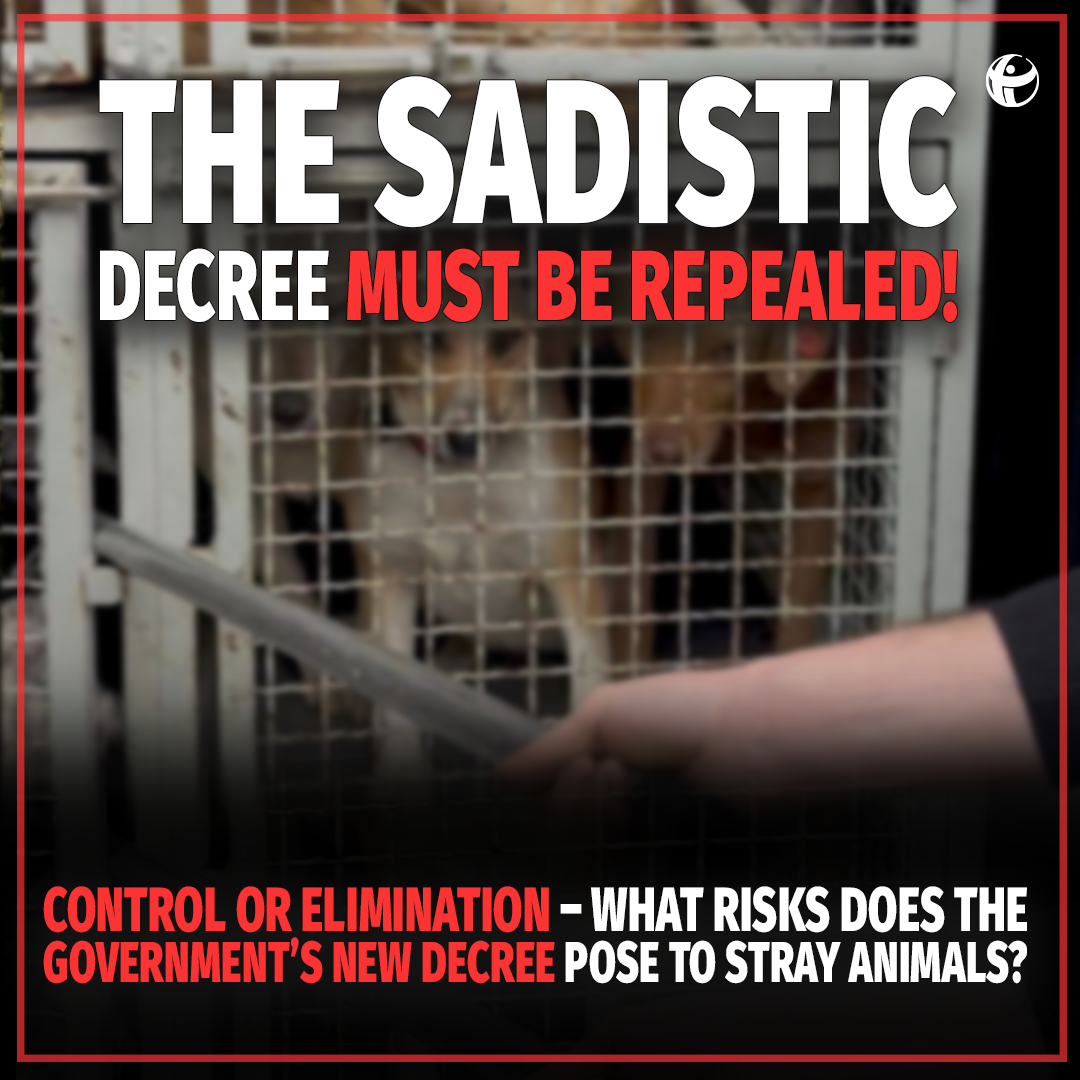
The problem of stray animals in Georgia has remained one of the significant social and legal challenges for years. Despite various measures, a substantial part of the problem remains unresolved. Reducing the excessive number of stray animals through sterilization/castration and vaccination is considered an internationally recognized and effective approach.
Against this background, the practice[1] of removing stray/community animals from their locations and not returning them causes public dissatisfaction, since such an approach is inhumane and at the same time contradicts the principles of animal welfare, and does not comply with either international standards or national legislation.
- What Does the Community Animal Population Management Program Entail and What Does the Government’s New Decree Provide For?
In Georgia, the law “On Domestic Companion Animals” is in force regarding animal rights, which was adopted in 2025. In accordance with this law and the Government’s 2025 decree, a pilot program for managing the population of stray and community animals was defined. In 2025, the National Food Agency was tasked with transferring 9,000 stray animals to shelters, sterilizing/castrating them, and returning them to their environment. As animal rights defenders note, many transferred animals disappeared. The Agency also frequently transferred already sterilized/castrated animals to shelters.
In February 2026, the Government approved the 2026 Dog Overpopulation Management Program. Municipal authorities are also involved in the implementation of this program together with the Agency. According to this decree, for the purpose of vaccination, sterilization, and testing for various diseases when necessary, the Agency plans to capture approximately 36,116 stray/community dogs. After completing the procedures, the Agency must return the dogs to their environment.
However, an exception was also defined, according to which it is prohibited to return dogs near schools, kindergartens, clinics, food establishments, markets, and playgrounds.[2]
Animal rights defenders note that dogs are taken away and not returned. They suspect that the transferred dogs are either left in uninhabited areas or euthanized. Changing the return location most likely implies removing animals to unfamiliar and/or uninhabited areas, which, in turn, most likely means their death.
For example, activist Salome Partswania notes that the dogs taken from Zugdidi were under the care of volunteers and were sterilized and tagged.[3] However, despite this, they were still taken away. As she was told, the dogs were being taken to the Kutaisi municipal shelter, from where they might be returned in a week or possibly in a month, but “not to places where there are many people — we will release them into nature.” Also, footage publicly disseminated clearly shows the forced removal of already tagged (vaccinated and sterilized/castrated) dogs.[4] Only part of the dogs taken on April 1 were returned.
For years, the issue of animal shelters has also remained unresolved. For example, the Batumi City Hall has been talking about a shelter for stray dogs for six years; several tenders were announced but later terminated. The stray dog shelter project was among the projects whose launch was announced by the Government of Adjara and the Batumi City Hall in October 2020, but the shelter has still not been built. In Batumi, in January 2026, shortly after the start of construction, the company that won the tender “discovered” that the soil of the project area in Chakvi was presumably unsuitable for construction. The construction of the shelter was postponed for an indefinite period.
Assessment
The practice of removing stray/community animals from their locations and not returning them contradicts both international standards and even the requirements of national legislation. It is inadmissible to cause unnecessary physical or mental pain to an animal. Under the same provision, reducing the number of stray animals is permissible only if it is carried out without pain and suffering, and during their capture, physical and mental suffering must be minimized.[5]
Control of stray animals must be carried out by humane methods. The purpose of the Convention for the Protection of Pet Animals is that states apply measures that do not cause unnecessary suffering to animals and ensure their welfare. The World Organisation for Animal Health guideline “On the Management of Stray Dog Populations” recommends the CNVR method (capture–neuter–vaccinate–return). According to the document:
- animals should not be relocated to another territory;
- changing territory causes stress, conflict, and mortality;
- returning animals to the same territory is considered an effective method.
The purpose of the Law “On Domestic Companion Animals” is to introduce humane principles and methods of care and population management of companion animals. According to the same law, animal welfare includes, among other things, access to food and water; disease prevention; protection from pain and suffering. Relocating an animal to another environment where these conditions are not ensured will constitute a violation of the regulation.
Moreover, according to Article 19 of the Law “On Domestic Companion Animals,” improper or cruel treatment of an animal is inadmissible, including any act that causes suffering. Removing an animal from its natural environment, which results in stress, lack of food, and conflict with other animals, may be assessed as a violation of the law, which may give rise to administrative and criminal liability.[6]
In addition to the above, paragraph 3 of Article 3 of Decree No. 412 provides for greater restrictions regarding community dogs than those already established by law. For example, the Law “On Domestic Companion Animals” prohibits feeding/community care only in specific institutions/buildings (schools, kindergartens, clinics, metro). The decree expands this list and also includes areas near public catering establishments, agricultural markets, and hotels. At the same time, it is not defined: within what radius the prohibition applies; by what criteria the territory is assessed, etc. Such a vague provision violates the principle of legal certainty and contradicts the law. It also creates a bad precedent for imposing stricter restrictions by a subordinate normative act than those established by law.
At the same time, relocating already sterilized, vaccinated, and tagged animals is also unjustified, since they no longer pose a threat of population growth, have a defined habitat, and their relocation increases the risk of mortality.
The use of inhumane methods cannot resolve the issue of overpopulation, because new animals abandoned by humans will continue to appear in the territory. A systemic solution to the problem requires controlling the reproduction of owned animals, expanding sterilization/castration programs, and preventive policies.
Based on all of the above:
- the exceptions prohibiting the return of animals (paragraph 3 of Article 3 of Decree No. 142) should be abolished;
- instead of relocating animals to other cities by inhumane methods, services should carry out vaccination locally, as was previously practiced;
- the relevant authorities should provide caretakers with information about the capture
- the animal and the reason for it, as well as information about the animal’s location and the timeframe for its return.[7]
[1] See: “Facts of Cruel Treatment of Stray Animals in Samegrelo,” Transparency International Georgia, June 4, 2014, https://shorturl.at/ziZyu; also see: “Kutaisi Stray Animal Shelter – Low-Quality Service Received for 90,000 GEL,” Transparency International Georgia, February 12, 2015, https://shorturl.at/4OOZM
[2] Article 3, paragraph 3, Government of Georgia Decree No. 412 of 25 February 2026.
[3] “I cannot find the dog I raised like my child” – “Stray dogs were taken from Zugdidi,” March 30, 2026, Radio Liberty, https://shorturl.at/NM9S Also see: https://www.facebook.com/share/r/183nBK3PS4/
[31.03.2026]
[4] source:: https://www.facebook.com/share/p/1E3VwatSUq/ [31.03.2026] https://www.facebook.com/share/p/18R8KzT2Sk/ [31.03.2026]
[5] European Convention for the Protection of Pet Animals, Strasbourg, 13.XI.1987, Article 3, https://rm.coe.int/168007a67d .
[6] Criminal Code, Article 259, “Animal torture, cruel treatment, or other violence against an animal”; Code of Administrative Offences, Article 104, “Improper treatment of an animal.”
[7] According to Article 18, paragraph 7 of the Law “On Domestic Companion Animals,” the authorized body of the municipality is obliged to undertake the necessary measures to locate the owner/caretaker (including publishing a photograph of the animal and detailed information about it on the website of the authorized municipal body and/or on social networks).