
93 Phrases Critical TV Channels Are Prohibited from Using
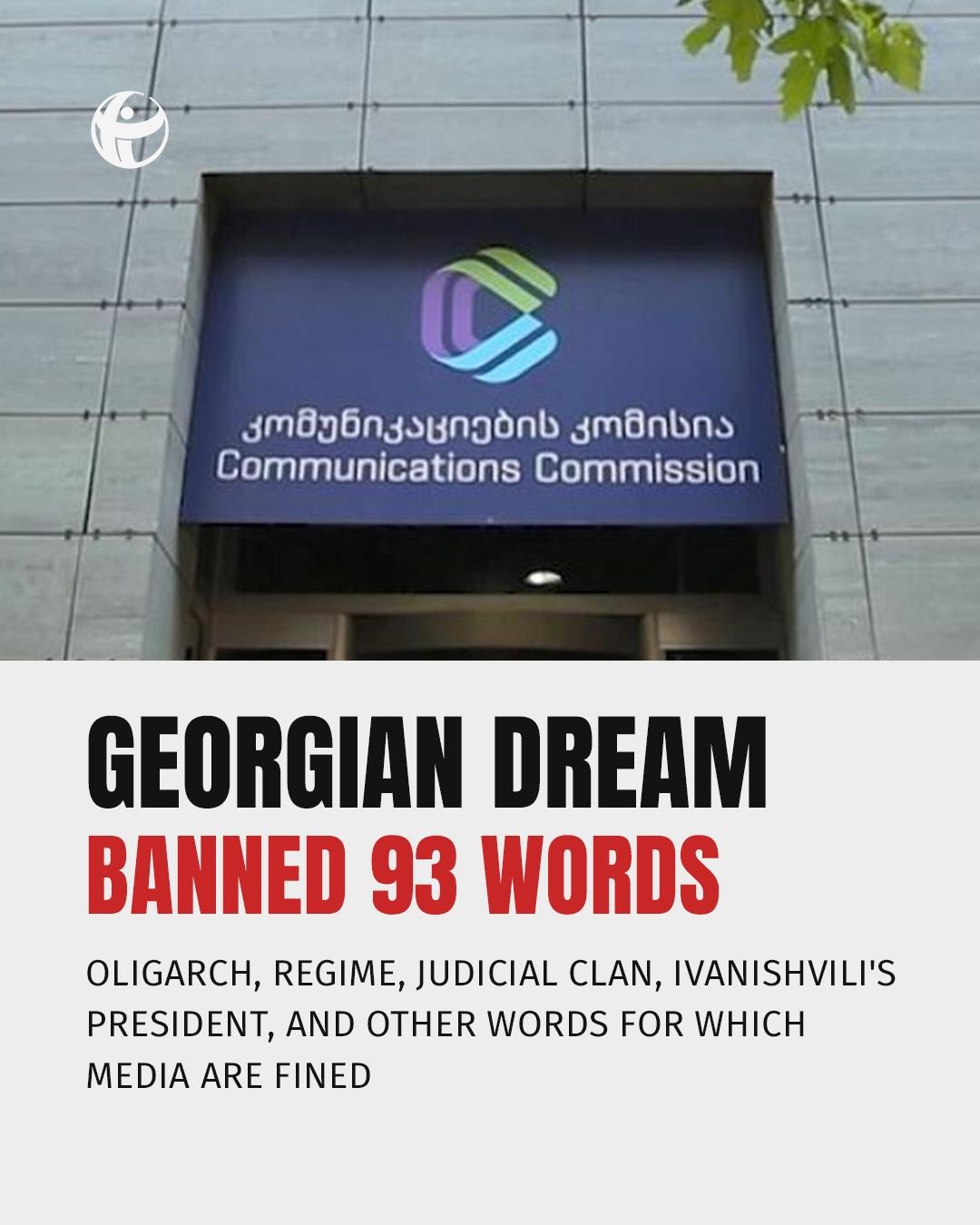
The Communications Commission continues to act as a censor. At a meeting held on October 1, the Commission fined critical television channel Formula for the third time - this time GEL 10,000 - for using words and phrases deemed unacceptable to Georgian Dream. The Commission’s decision was supported by its Chair, Goga Gulordava, and two commissioners, Ivane Makharadze and Ani Vazagashvili. The other two commissioners, Natia Kukuladze and Ekaterine Imedadze, did not attend the meeting.
Overall, over the past six months, the Commission has issued formal reports against critical TV channels TV Pirveli and Formula on this same basis seven times - four times against Formula and three times against TV Pirveli. Based on these reports, the Commission initially issued the broadcasters verbal warnings, and subsequently fined them GEL 2,500 each time, followed by GEL 5,000 fines on the next occasion (for details, see the link). On October 1, the Commission additionally fined Formula GEL 10,000. Most likely, the Commission will continue this harmful practice and, in the near future, will fine TV Pirveli for the same reason. This is because the Commission typically follows a predictable pattern, moving in a cycle and penalizing broadcasters one after another.
It is clear that, through this approach, the Communications Commission is seeking to cripple television channels that are already operating under severe financial constraints. The Commission also has the authority to suspend their broadcasting licences, which is particularly alarming.
It is true that, in parallel, the Commission has also placed pro-government channels - Imedi, POSTV, and Rustavi 2 - under monitoring. However, observing the process leaves the impression that this has been merely a formal exercise, intended to present the Commission to interested parties as an objective observer and arbiter. From the outset, it appeared clear that the Commission’s primary objective was to penalize critical media outlets and weaken them and/or force them out of business through financial fines.
The Communications Commission threatened to launch content monitoring of critical broadcasters after February 24, 2026, when the United Kingdom sanctioned pro-government propaganda television channels Imedi and POSTV for deliberately disseminating false information about Russia’s war against Ukraine and supporting Russian disinformation.
●What Does the Communications Commission Accuse Critical Broadcasters Of?
The Communications Commission typically accuses broadcasters of violating the principle of impartiality, as well as reporting the news based on personal attitudes and opinions. Transparency International Georgia reviewed all the memoranda prepared by the Commission concerning critical broadcasters - seven documents in total - and compiled a list of the words and phrases prohibited by the Commission.
The review found that the Commission prohibits critical broadcasters from using a total of 101 words and/or phrases: 33 in the case of TV Pirveli and 68 in the case of Formula. In some cases, the words and phrases prohibited for the two critical broadcasters overlap. Overall, the Commission prohibits the use of 93 distinct words and phrases. (For the full list of words and phrases prohibited by the Commission for critical broadcasters, see Table 1.)
The words and phrases prohibited by the Commission for critical television channels include: “regime,” “prisoners of conscience,” “oligarch,” “police officers who are false witnesses,” “political prisoners,” “political hostages,” “repressive policy,” “Ivanishvili’s prime minister,” “the so-called education reform,” “Georgian Dream police,” “unlawful imprisonment,” “the Scroll-Screenshot Department,” “Georgian Dream government,” “repressive laws,” “the regime’s court,” “Ivanishvili’s president,” “Georgian Dream’s State Security Service,” “judicial clan,” and so on.
In addition to prohibiting specific words and phrases, the Communications Commission requires critical broadcasters to report the news in a dry manner, stripped entirely of commentary and analysis. For example, according to the memoranda, the Commission also considers the following statements by journalists and presenters to be unacceptable:
- “This is a new stage in restricting freedom of speech and replacing the law with street justice. Georgian Dream is beginning to establish a so-called morality police. The informal unit will be led by MMA fighter Giorgi Kartvelishvili. A Chechen-style squad is threatening immediate retaliation against anyone it believes has insulted sacred values, religion, ancestors, or history.”
- “The head of the informal unit effectively announced violence in front of the cameras. The group, backed by the government, plans to respond immediately to what it considers insults to sacred values, religion, and history. He reportedly came up with the idea after the alleged insult to Nodar Dumbadze. In reality, Georgian Dream has copied the Chechen model, where athletes are granted an official mandate and given permission to use violence. The ruling team and its supporters will decide for themselves who to punish, how to punish them, and how to silence critical voices.”
- “The police began hunting down activists late at night. First, they detained Tornike Toshkhua. The man, who had been released from prison just a few weeks earlier, was conducting a street survey. However, the police lost their nerve and detained him within seconds, which sparked a strong wave of solidarity. Within minutes, dozens of young people had gathered outside the City Assembly.”
- “Georgian Dream is also counting on a pro-Russian politician in Washington. The propaganda is portraying the oligarch’s MPs’ visit to Washington as an effort to restore relations with the Trump administration. In reality, however, their host is a conspiracy theorist and politician who has acted against Ukraine and has close ties to the Kremlin.”
- “Ivanishvili’s government is blocking the country’s path to EU membership and further intensifying disinformation in an attempt to once again shift the blame for its own wrongdoing onto Europe. Representatives of Georgian Dream are trying to portray this outcome as the result of Europe’s double standards rather than their own policies, which are clearly seen as a departure from democracy and European values. Against this backdrop, the regime needs to step up its efforts to spread this disinformation even further, especially as EU accession negotiations with Ukraine and Moldova are now actually getting underway…”
- “…Irakli Kobakhidze listened to even these chants without any apparent concern in the Iranian parliament and stood alongside terrorists,” and so on.
The Communications Commission considers the use of these words and phrases by journalists to constitute “the broadcaster’s expression of an opinion and personal attitude toward the activities of state bodies/institutions. Accordingly, the broadcaster is reporting on current public policy issues based on its personal attitude or opinion, thereby violating paragraph 5 of Article 54 of the Georgian Law on Broadcasting.”
Conclusion
Once again, we emphasise that it is deeply concerning that the Communications Commission has the power to regulate broadcasters’ content and, on this basis, impose financial sanctions and suspend their broadcasting licences. This is particularly alarming given that, against the backdrop of firmly established and clearly evident state capture in Georgia, the Commission has for years been composed of commissioners loyal to and affiliated with Georgian Dream. (For details about the members of the Communications Commission, see the link.) There are also numerous questions surrounding the Commission’s decisions and concerns that it has acted to advance the interests of the ruling party and in a biased manner. The Communications Commission should not operate as a censor, nor should it be used as a mechanism for punishing critical broadcasters. In line with international practice, disputed issues should instead be addressed through self-regulatory mechanisms. Promoting and supporting self-regulation should be one of the Commission’s primary objectives — rather than serving the interests of Georgian Dream and penalising broadcasters for criticising and exposing representatives of the ruling party.
Chart 1: Words and phrases prohibited by the Communications Commission for critical broadcasters
|
# |
Formula |
TV Pirveli |
|
1 |
The Opposition Persecution Case |
Prisoner/Prisoners of Conscience |
|
2 |
Regime |
Those Convicted on the Basis of Testimony from False-Witness Police Officers |
|
3 |
Ivanishvili’s Government |
Georgian Dream Investigation |
|
4 |
Georgian Dream’s Prosecutor’s Office |
Oligarch |
|
5 |
The Oligarch’s Team |
Political Prisoners |
|
6 |
Georgian Dream’s Parliament |
Non-Existent Crime” |
|
7 |
Repression |
Political Hostages |
|
8 |
Georgian Dream Government |
Ivanishvili’s Regime |
|
9 |
Ivanishvili’s Prime Minister |
[Journalist], Whom Georgian Dream Punished as an Example to Others |
|
10 |
The Chairperson of the Georgian Dream Parliament |
Georgian Dream MPs |
|
11 |
Georgian Dream Mayor |
The Oligarch’s Party |
|
12 |
[Bidzina] Ivanishvili’s MP/MPs |
The Persecution of Activists Continues |
|
13 |
The Oligarch’s Ministry |
Bidzina Ivanishvili’s Team |
|
14 |
Georgian Dream Minister |
Repressive Policy |
|
15 |
The Oligarch’s Party |
Ivanishvili’s Repressive Policy |
|
16 |
Georgian Dream Foreign Minister |
The Georgian Dream’s Violent Regime and Policies |
|
17 |
Georgian Dream’s Ministry of Internal Affairs |
The Ministry of Culture Controlled by Georgian Dream |
|
18 |
The oligarch’s Parliamentary Speaker |
Regime |
|
19 |
Ivanishvili’s Foreign Minister |
Ivanishvili’s Prime Minister |
|
20 |
The Oligarch’s Regime |
Georgian Dream Police |
|
21 |
The Chairperson of the Oligarch’s Parliament |
Television Channels Controlled by [Ivanishvili] |
|
22 |
Georgian Dream Court |
Georgian Dream is Choosing Dictatorship |
|
23 |
Georgian Dream Prime Minister |
The Case of 11 Prisoners of Conscience |
|
24 |
The Georgian Dream Regime |
Blatantly Fabricated |
|
25 |
Judicial Clan |
Georgian Dream Minister |
|
26 |
Razden Kuprashvili’s Agency |
The So-Called Education Reform |
|
27 |
Ivanishvili’s Party |
The Night of Hunting Down Activists |
|
28 |
Georgian Dream’s State Security Service |
The Terror Did Not End There |
|
29 |
Georgian Dream Verdict |
Georgian Dream’s State Security Service |
|
30 |
Georgian Dream Prime Minister |
The Scroll-and-Screenshot Agency |
|
31 |
Georgian Dream Parliament Member |
[The Ministry of Internal Affairs] Launched a Major Manhunt |
|
32 |
Ivanishvili’s Interior Minister |
A Major Manhunt on the Capital’s Central Avenue |
|
33 |
Ivanishvili’s President |
The Hunting Down of Activists |
|
34 |
Members of the Georgian Dream Government |
|
|
35 |
Head of the Georgian Dream Government |
|
|
36 |
Ivanishvili’s Regime” |
|
|
37 |
The regime’s Prosecutor’s Office |
|
|
38 |
Georgian Dream investigative Agency |
|
|
39 |
Georgian Dream’s Ministry of Foreign Affairs |
|
|
40 |
Georgian Dream’s President |
|
|
41 |
Pro-Government Rustavi 2 |
|
|
42 |
The Regime’s Court |
|
|
43 |
The Oligarch’s Inner Circle |
|
|
44 |
Opponents of the Regime |
|
|
45 |
The Georgian Dream Government Administration Building |
|
|
46 |
Georgian Dream Government Administration |
|
|
47 |
Georgian Dream Health Minister |
|
|
48 |
Unlawful Detention |
|
|
49 |
Propaganda Mouthpieces |
|
|
50 |
Government Propaganda |
|
|
51 |
The Oligarch’s MPs |
|
|
52 |
Unlawful Imprisonment |
|
|
53 |
Their Own Propagandists |
|
|
54 |
Georgian Dream Government |
|
|
55 |
Georgian Dream’s Rule |
|
|
56 |
[Bidzina] Ivanishvili’s team |
|
|
57 |
Georgian Dream MPs |
|
|
58 |
The Scroll-and-Screenshot Department |
|
|
59 |
Georgian Dream MP |
|
|
60 |
Representatives of Ivanishvili’s Government |
|
|
61 |
Repressive Laws |
|
|
62 |
Georgian Dream Interior Minister |
|
|
63 |
Their Own Propaganda Broadcast |
|
|
64 |
Georgian Dream’s Ministry of Finance |
|
|
65 |
Ivanishvili’s Government |
|
|
66 |
Imprisoned on Political Grounds |
|
|
67 |
Repressive Provisions |
|
|
68 |
Georgian Dream and its Satellite, People’s Power |
|
Source: Memoranda prepared by the Communications Commission for broadcasters